
The analysis is free.
Every chart and score, with no trial and no time limit. No upgrade prompt stands between you and your own runs.

Adaptive running plans from your recent runs, with daily training guidance, race predictions and analytics you can check using published formulas.
Free with no time limit. Export or delete your data any time.From your first 5K to your next ultra — every plan is built around your schedule and your current fitness.
Missed a run, or feeling flat? The days ahead are worked out again from what you actually ran and how recovered you are.
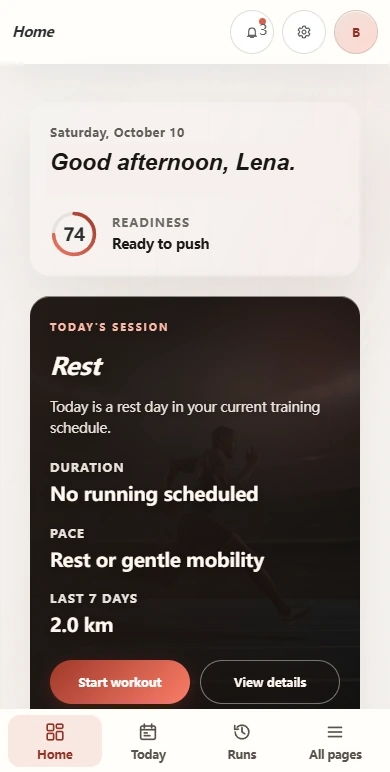
Open Today each morning for a clear read on recovery and load — the reasons beside it, and a simple note on how to run.

See your predicted finish update with every run — for the 5K, 10K, half marathon and marathon — worked out from your best recent runs.

Today’s session, the pace to hold and a one-line note from your coach — nothing else to figure out.
Example data
Every chart and score, with no trial and no time limit. No upgrade prompt stands between you and your own runs.

Running fitness can use a heart-rate rule or Daniels’ race equation. Training load compares 7-day and 28-day weighted averages. The methods document gives the inputs, worked examples and limits.
Read the formulas
Export your profile, runs, shoes, saved races and supported training records, with GPS tracks optional. Some wellness and muscle-training records are not included. Export and account deletion are available in Settings without an upgrade.
Export scope and privacyRunning analytics are easier to use when you can see the inputs and check the calculation. Here is what sits behind the estimates.
Fitness estimates start with a run’s distance, moving time and date. Heart rate adds a separate estimation method, while GPS tracks enable route maps. Some runs are excluded by distance and pace filters; the methods show which runs qualify.
Check imports and data requirementsWith usable heart-rate data, HermesRuns applies its own heart-rate rule. Without it, qualifying runs use Daniels’ race equation. These methods can produce different values. VDOT is a running-performance estimate; a laboratory VO2max measurement is different.
Read the methods documentThe Daniels race equation gives 38.3 for these inputs. This shows one equation, rather than a person’s full race forecast. An easy run at the same pace can understate race fitness, and a run with usable heart rate follows a different method.
Read the race equation
These methods are documented with the HermesRuns project. Check the source or report a calculation that does not match your runs. HermesRuns project source
All the analysis is free. Supporter is optional — it keeps the servers running.
Payments open soon.
HermesRuns is a running analytics and adaptive training app. It uses your recent runs to suggest training, estimate race times and show calculations you can inspect. Connect Strava or Garmin, or upload GPX, FIT or TCX files from compatible devices such as COROS. Depending on the available data, fitness estimates use a heart-rate rule or Daniels’ race equation. VDOT is a running-performance estimate, not a laboratory VO2max measurement. Heat, hills, easy effort and sensor errors can affect the results; a predicted finish time is not a guarantee.
No. You can use phone-recorded runs synced through Strava or upload a supported activity file. Heart rate is optional for pace-based fitness estimates. GPS tracks are needed to draw your routes on a map.
Your completed runs stay in your history. Upcoming sessions can be recalculated from your recent runs and recovery signals. Check the updated schedule before your next session.
HermesRuns estimates fitness from eligible runs in the last 90 days, then uses Daniels’ equations and recent performances near the target distance to estimate a finish time. Heart-rate data can change the fitness estimate. Heat, hills, easy effort and sensor errors can affect the result.
Yes. Connect Strava or Garmin in Settings, or upload GPX, FIT or TCX activity files. COROS history comes through file upload. Distance, time, heart rate and GPS availability depend on what the source records and the file contains.
You do not need a full 90 days to start. The fitness estimate uses up to three of the highest eligible estimates within that window. With one or two qualifying runs, it uses those runs and can change more as you add data. Runs shorter than 1.5 km are excluded from this calculation; the methods explain the other filters.
Yes. Settings includes export and account-deletion controls. Export covers your profile, runs, shoes, saved races and supported training records, with optional GPS tracks. It does not include every data category. The privacy policy explains the current scope, retention and your choices.
No. Supporter is paid in advance for the months you choose and never renews — there is nothing to cancel.
